Showing posts with label economics. Show all posts

Thursday, November 10, 2011

The Union Fix - Part 2

In part one of “The Union Fix” I introduced the immediatestep towards dismantling the strangle hold unions have on U.S.manufacturing.  In part two, I discussthe longer-term solution to finally break the cycle of anti-competitiveness andbring manufacturing back to our nation.

In Washington State,the IAM waged a strike on the Boeing Company in 2008 resulting in months ofdelays and lost production.  Afterreaching a contract agreement, Boeing sought assurances from the IAM that itwould not strike again.  When the IAWfailed to meet this demand Boeing made the decision to build a second 787assembly line in North Carolina,a right-to-work state.  Although nowembroiled in a highly publicized lawsuit against Boeing over the decision, theIAM provides a perfect example of how unions price themselves out of themanufacturing labor market and drive companies to alternative markets. 

The Boeing case also illustrates part of my proposedsolution.  Twenty-two of our nation’sStates are right-to-work states. However, the liberal foothold in the remaining 28 States is unlikely torelent sufficiently to permit the adoption of right-to-work laws.  Therefore, we need a compellingcompromise. 

Large corporations are forbade from controlling too much ofa given market per existing anti-trust laws. The word monopoly in the halls of the Federal Trade Commission is aspringboard to action and eventual divestiture of assets from the offendingfirm.  However, these same principleshave not been applied to unions.  Unionsthat represent all employees to a particular firm or industry have a monopolyon that labor market.  Therefore, weshould extend anti-trust laws to unions via legal precedent orlegislation.  In so doing, no singleunion would be able to have a monopoly on labor.

The outcome of this step would be a dismantling of theAFL-CIO, SEIU, and Change to Win Federation. In addition, no one union could represent all the employees in aparticular trade at a single company. Therefore, more than one union would be required; in cases where noadditional union is ratified, at least a portion of the employees would not beunionized.  In all cases, the unionswould be forced to compete with one another for members.  Competition would tend to put downwardpressure on dues and inherently limit the amount of money available forpolitical manipulation.

This solution is effectively a compromise in that it stillallows a closed shop for unions, it preserves worker’s rights to unionize, andit gives workers greater choice in representation.  Finally, from the perspective of the firms,there would be competition in the labor market giving the companies greaterflexibility over the compensation packages. In turn, this helps prevent ludicrous pension benefits, exorbitant wagesfor menial labor, and ultimately makes the U.S.manufacturing industry more competitive against a world of low pricedalternatives. 

Read more like this at Aaron Opine

Thursday, November 3, 2011

The Union Fix - Part 1

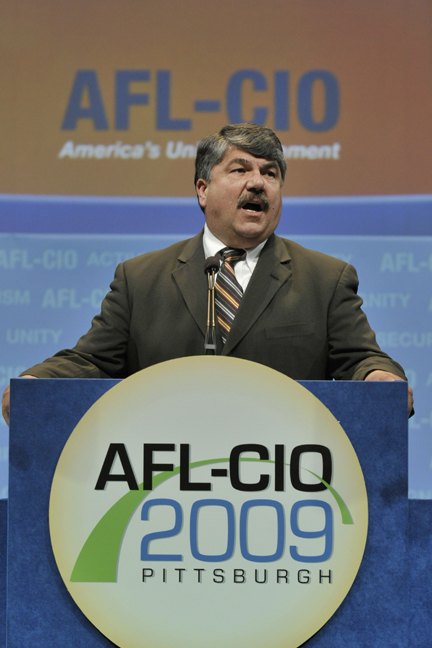
Photo by Bill Burke
Any non-imbecile can tell you that unions have exacerbatedthe decline in manufacturing in the United States. Their demands made upon the threat of work stoppages have enabled themto amass pension funds that have crippled the likes of Ford, GM, and Chrysler.  Many States and municipalities are likewisestumbling under the weight of massive public employee union pensionprograms.  Like the foreign substanceinvading a festering wound, we must winnow the power of unions in our countryto restore our predominance in manufacturing. There are two key steps towardsstripping unions of their power and influence in order to reinstate ourmanufacturing base and thereby strengthen our economy (Note that addressing theunions must be done in concert with far reaching tax and regulatory reform –resolving our union problem with not be sufficient alone).  The first is immediate action to be taken bysensible persons holding unions positions; the second is longer-term and canonly be accomplished at the State and Federal levels.

The first step is for all concerned union representedemployees to become objectors.  When Igraduated from college I went to work for a company that was infected with anagency shop union.  Initially, I chose tobe a Beck Objector (see Communication Workers of America v. Beck for legalhistory), but still paid an “agency fee” which was nearly as much as the fullunion dues.  About a year later I learnedthat a significant portion of my agency fee was being used as campaigncontributions towards democratic candidates. Under Section 701(j) of Title VII of the Civil Rights Act of 1967,employees with bona fide religions objections cannot be coerced into supportingunions.  I wrote a letter to the unionshowing how every candidate supported by my fees was an abortion advocate.  I concluded by confirming that I viewabortion as an unethical and abhorrent per my religious convictions.  The union agreed (as required by law) toallow me to contribute to a non-religious charity of my choice instead of payingunion dues.

Although not all union represented employees are similarlyinclined to depose of unions, it is quite likely that many would be put off bytheir union’s prolific use of union dues to support the campaigns ofpoliticians and legislation that offends their religious sensibilities.  Therefore I encourage all union employees toinvestigate how their dues are spent – following the paper trail all the way tothe AFL-CIO if necessary.  With the veilof faux-legitimacy lifted, I’m willing to wager many more union employees wouldbecome religious objectors.  Doing sowould strip unions of the more than $400 Million they spend annually onpolitical influence that has effectually stripped our nation of its competitivenessand propelled us closer to socio-Marxism.

For more information about becoming a Religious Objector Iencourage you, or your union worker friends, to visit www.choosecharity.org and www.nrtw.org.

This step is critical and immediate.  However, it is not sufficient to curtail theinfluence, and therefore damage, of unions over our government.  Next week I will share step two – a longerterm solutions with greater reach and impact.

READ MORE LIKE THIS AT AARON OPINE

Thursday, January 15, 2009

JENNY McCARTHY - Suavenomics ?

Jenny McCarthy has teamed up with Suave shampoo to promote their new ‘Beauty Stimulus Campaign’ also known as Suavenomics. The actress hit Times Square in bustling Manhattan and waved a placard.


I love marketing and advertising in general, but the audacity of the ad companies to aggressively market a recession in the middle of a recession to the victims of the recession is mind boggling ! Kudos Gentlemen Kudos !
Suave's suavenomics campaign